


CODA X ATS
Our auction framework is supported by rigorous analytics that continuously monitor execution quality, quote stability, fill rates, price improvement, market impact, and adverse selection. This data-driven approach allows us to validate the benefits of competitive liquidity discovery. Clients source unique order by order on-demand auction liquidity opportunities in confidence that every order is evaluated for the best possible outcome.
CODA MICRO
MICRO is a user-initiated adjustable milliseconds auction that transacts against aggregated liquidity streams at or within the NBBO. The facility lets users transact without revealing the direction or size of their trading interest. The model utilizes a price, size, time execution hierarchy where all responses are ranked at the end of the auction.
CODA TURBO
TURBO is a first-to-respond, first-to-trade model for latency sensitive Liquidity Seekers. During the open auction window all qualified contra responses actively execute until the order is satisfied or the adjustable millisecond auction timeframe closes.
CODA FUSE
FUSE seamlessly captures today’s diverse algorithmic liquidity from multiple sources and order types. Multilateral execution in a single print virtually eliminates leakage. The only venue where you can trade simultaneously with an aggregated number of conditional interests.
CODA MICRO
Matching Protocol Selection
One to One executions utilizing a Price/Size/Time Model to prioritize Price Improvement then Size to minimize market impact
Auction Initiation
Initiators send marketable orders which generate symbol-only alerts to CODA MICRO subscribers and interact with resting liquidity
Price Determination
Executable contra responses cross within the NBBO at the end of the customizable auction window, responses are ranked by a Price/Size/Time priority
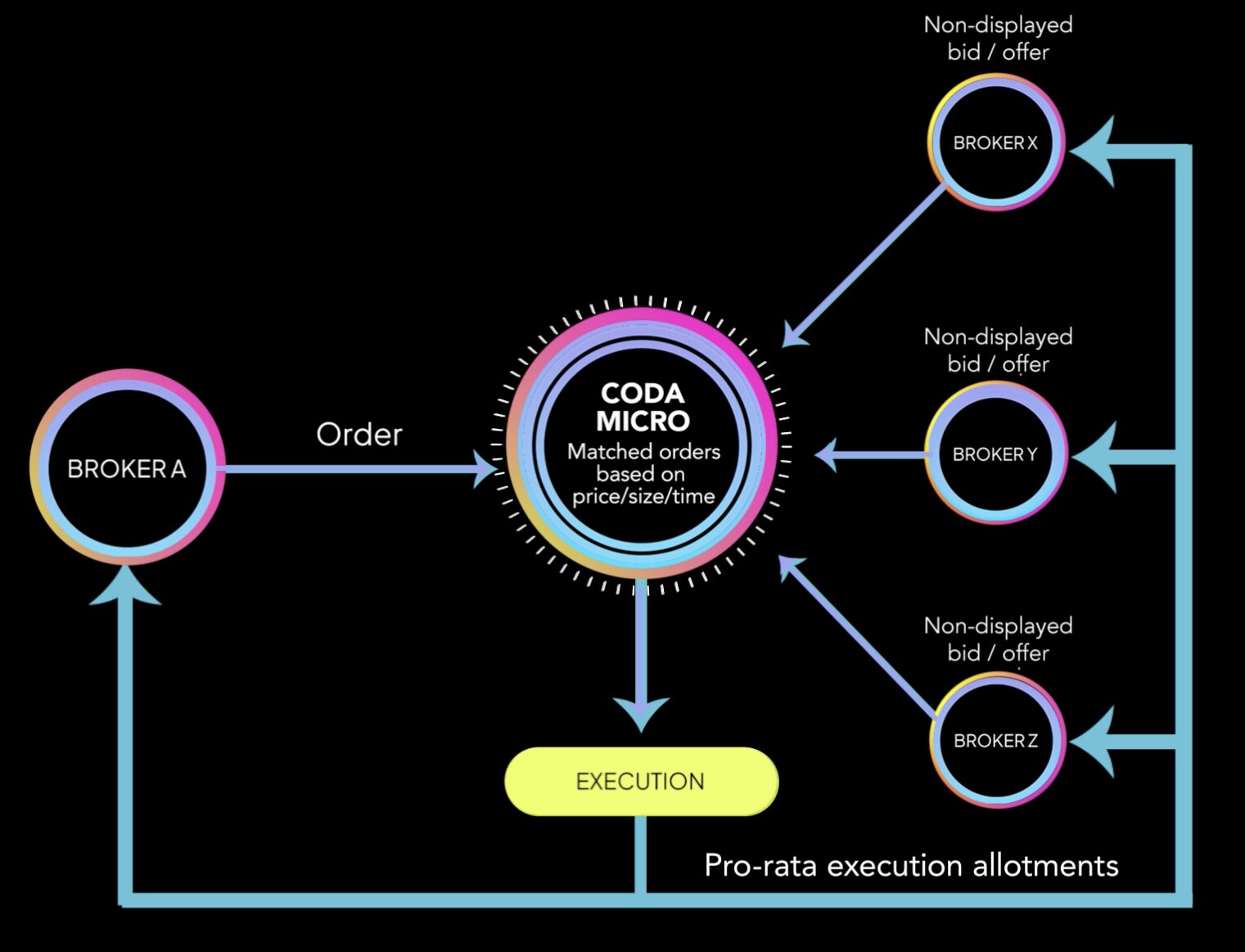
MICRO Matching Logic
CODA TURBO
Matching Protocol Selection
One to One executions utilizing a Time/Price model for lower latency executions
Auction Initiation
Initiators send marketable orders which generate symbol-only alerts to CODA MICRO subscribers and interact with resting liquidity
Price Determination
Executable contra responses cross as they become available within the NBBO, price improvement goes to the auction initiator
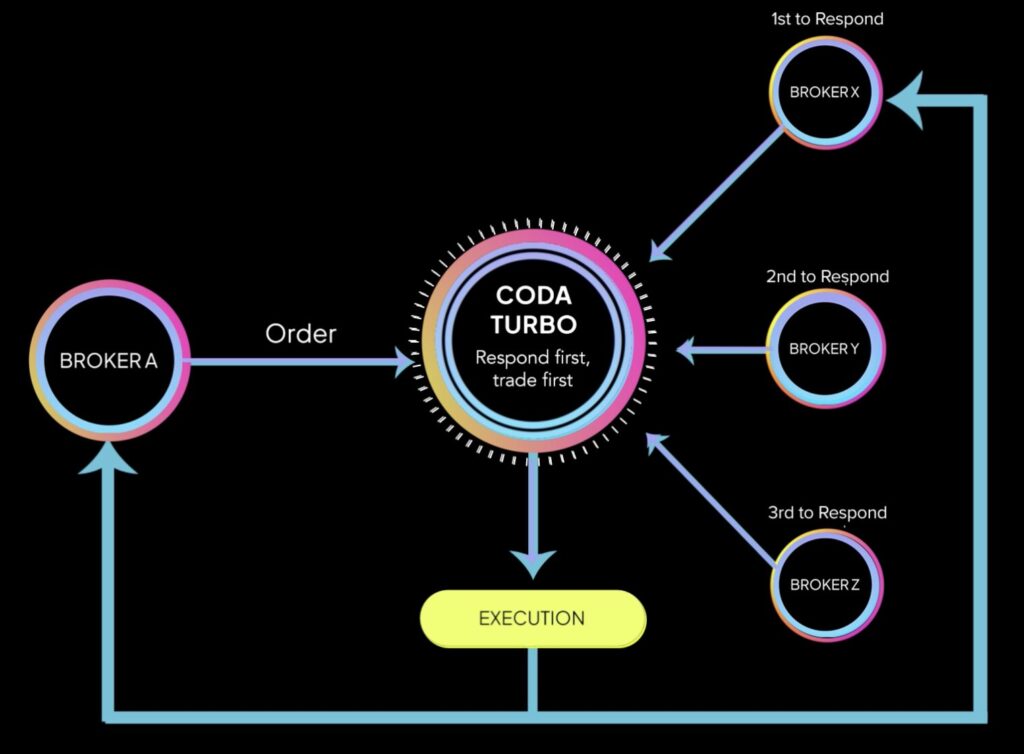
TURBO Matching Logic
CODA FUSE
Matching Protocol Selection
Executes trades multilaterally & simultaneously
Auction Initiation
Aggregates diverse liquidity from multiple sources & order types
Price Determination
Executable contra and eligible same side responses cross within the NBBO at the end of the auction window at a price where the most shares will trade
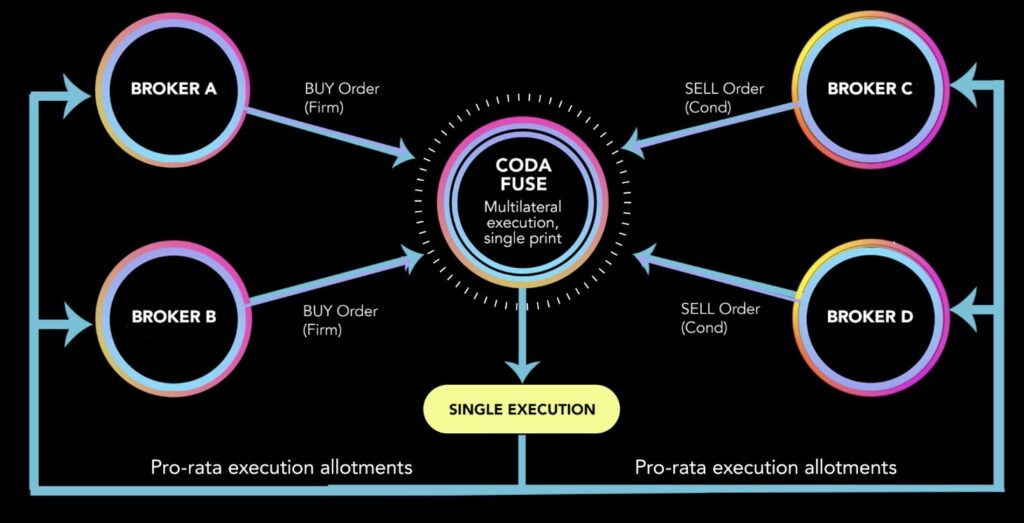
FUSE Matching Logic

Competitive Price Discovery
Liquidity providers compete for every eligible order rather than relying on passive queue priority.

Differentiated
Liquidity
Access unique, on-demand liquidity unavailable through traditional matching models.

Measurable Execution
Quality
Higher fill rates, meaningful price improvement, and stable post-trade outcomes.

Continuously
Monitored
Quote stability, market impact, and adverse selection are continuously analyzed to validate auction performance.

Simple to
Connect
Standard FIX integration with flexible workflows and dedicated implementation support.
 Tim Lang, the CEO and Founder of Global Liquidity Partners, is an equity trading professional with over 40 years of Wall Street experience. Tim’s vision of GLP in 2010 was driven by his belief that there was a technology void in the equity marketplace due to all of the emerging fragmentation of trading venues. His goal was to create a best-in-class, performance-driven equity execution services platform. His role at GLP is all-inclusive as he remains active in strategy design, marketing, client relationship management and staffing.


 Jason joined CODA Markets in 2015. As the Director of Execution Services, Jason builds and maintains CODA’s custom routing strategies and downstream relationships. Jason is also actively involved in the Security Trader’s Association of Chicago as the current Vice President and founder of the Young Professionals group for students and industry professionals under 30. Jason studied Finance and Economics at Colorado State University and DePaul University. Outside of work, Jason likes to hunt, fish, and other outside activities. He holds FINRA Series 7, 24, and 66 licenses.
 Upon joining CODA 12 years ago, Joe has been at the forefront of the ATS’s auction products, such as CODA Fuse, while enabling customizable trading solutions for all customers. Bringing with him his previous equities experience in both buyside and sellside roles, Joe drives innovation at the CODA Markets ATS with his understanding of market dynamics and a passion for leveraging technology to strive for best execution. Joe received his Bachelor of Economics and Finance degree from Loyola University in New Orleans. Outside of work, Joe enjoys playing hockey, tending to his chickens, and spending time with his family. He holds FINRA Series 7, 99, and 63 licenses.
 Zack is Head of Sales for CODA Markets, managing a team focused on obtaining new business and maintaining strong relationships with our existing client community. Prior to joining CODA, Zack spent a decade at a similar firm as Head of Execution Services after cutting his teeth in enterprise datacenter solutions at Dell. Electronic Trading was a natural fit after years of implementing robust systems, networks, and redundancy plans while at Dell. Working from New York and Los Angeles, Zack likes getting to know our clients, on both coasts, through various activities outside of work. He earned a degree from James Madison University in International Affairs and Spanish. Outside of work, Zack can be found at the beach, hiking with my family, or watching just about any sport. He holds FINRA Series 7, 57, 63, 24 and 99 licenses.